Wednesday, May 28, 2008
Memorial vacation
My vacation was okay. I went to Palisades Mall to watch Indiana Jones with my family. The movie was highly anticipated by many Indiana Jones fans, but the movie was horrible. I'm not a big Indiana Jones fan, but my dad who is also thought it was horrible. I also went to a friend's birthday party on Suday and had a barbeque with my family on Memorials day.

Monday, May 19, 2008
Outline
What is the question you are answering in your own words?
Is collectivism good or bad?
What is your thesis statement? This sets up the entire paper
with your focus and direction.
Suppressing individual desires to maintain interests of the society does exact opposite of what it intended to do; rather than preserving the society, it destroys it.
BODY PARAGRAPH 1
What is the topic/idea of this paragraph?
Collectivism forces individuals to accept what the society demands them to do.
What quote(s) ideas from research will you use to help prove your points?
a. “Rand suggests that society should be sought out only when a person chooses it, as a second thought to what the individual wants, and that it should be only with those people whom the individual chooses.”
b. “like stone, crushing [others] beneath it “
What example(s) from the book(s) will you use to help prove your points?
a. Equality wanted to be a scientist but the council made him a streetsweeper.
BODY PARAGRAPH 2
What is the topic/idea of this paragraph?
Collectivism hinders technological growth. Collectivist Councils suppress individual’s scientific knowledge because not all men agree with it.
What quote(s) ideas from research will you use to help prove your points?
a. “many strange things, of towers which rose to the sky ... and of the wagons which moved without horses, and of lights which burned without flame. But those times were evil. And those times passed away, when men saw the Great Truth which is this: that all men are one and that there is no will save the will of all men together”
What example(s) from the book(s) will you use to help prove your points?
a. Council shuns Equality’s rediscovery of electricity
BODY PARAGRAPH 3
What is the topic/idea of this paragraph?
The society has significant effect on the growth of individualism. If the society prevents growth, then great individuals will not develop at all.
What quote(s) ideas from research will you use to help prove your points?
a. “the individual is not an isolated monid, but a social product. His
ideals and interests, his very language and logic, everything, in fact, that enables him to think at all, is socially given him.“
What example(s) from the book(s) will you use to help prove your points?
a.. The World Councils, the greatest minds in the world, are not as great as Equality thought. They are molded into the dumbfounded society that prohibits human advances.
CONCLUSION
What should we now understand after reading your paper? Where idea(s) does your paper lead to?
a. Individualism is almost a holy right that we should enjoy.
b. Individualism is a key factor in technological, moral, and social advances.
Wednesday, May 14, 2008
Cornell Notes 3 (from Source 2)
TITLE: Robert Welch: John Birch Society Resolution (1970)
AUTHOR: Issues: Understanding Controversey and Society
YEAR PUBLISHED: 1970
Main Idea #1: Collectivism only leads to disaster. Use of violence and trickery to keep collectivism alive only begets more violence and trickery.
Summary:
To preserve collectivism people use pseudo-science and propagandas to control the people's minds. Because it is human nature to be selfish and greedy, collectivism values the society to suppress such greed.
Quote:
"Because of the very nature of man, the temptingly presented road to collectivism is always the road to moral degradation and eventually to a stultifying spread of poverty for all. "
" such a system can only be kept in existence by the use of trickery, force, and cruelty, it also leads inevitably to the loss of all freedom"
Question:
Cornell Notes 2 (from Source 1)
TITLE: Technology in the Dystopian Novel
AUTHOR: Gorman Beauchamp
YEAR PUBLISHED: 1986
Main Idea #1: Technology has different effects on different dystopian novels
Summary:
In the Anthem technology is controlled and influenced by collectivism. The society in Anthm rejects scientific discoveries that would be praised today. The idea that all must work on and agree with the discovery hinders technological growth.
Quote:
" [Rand] presents a future where the ideological imperative proves stronger than the technological imperative--a nightmare pastoral where the shamans of superstition have banished the scientists."
Questions:
Wouldn't the ignorance of the people's interest for technological advances also lead to disaster? Look at the Industrial Revolution. People traded technology for misuse of laborers and use of child labor to support such technological advances.
Tuesday, May 13, 2008
Cornell Notes 1 (from Source 4)
TITLE: Anthem Study Guide: Chapter X-XI
AUTHOR: Sparknotes
YEAR PUBLISHED: 2006
Main Idea #1: The meaning of objectivism, egoism, and individualism relies on the fact that individuals are above everything
Summary:
Equality 7-2521 learns the evil of collectivism. Rand uses Equality to “[lay] out in plain language the meaning of objectivism, egoism, and individualism”. Rand criticizes collectivism that it is “like stone, crushing [others] beneath it” while praises individual that “freedom is a treasure, and the sense of self is god to be exalted and worshipped.”
Quote:
“Rand suggests that society should be sought out only when a person chooses it, as a second thought to what the individual wants, and that it should be only with those people whom the individual chooses.”
Question:
“Critics of Rand are repulsed by the blatant selfishness she professes. They argue that humankind comes together into society in order to provide and be provided for, and that in the company of others, humans gain as much from their peers as they give to them.”
Who are theses critics? Any names I can cite?
Thursday, May 8, 2008
Source 5
Utopian Studies, Spring 2006 v17 i2 p392(5)
Robert Mayhew, ed. Essays on Ayn Rand's Anthem.(Book review) Cox, Stephen.
Full Text: COPYRIGHT 2006 Society for Utopian Studies
Robert Mayhew, ed. Essays on Ayn Rand's Anthem. Lanham, MD: Lexington-Rowman & Littlefield, 2005. ix + 337 pp. $28.95
Ayn Rand's novel Anthem is one of the most popular works of utopian literature. It is a poetic, evocative book, a book that has the distinction of being both a utopia and a dystopia. Equality 7-2521, Rand's engaging hero, is born into a collectivist society in which everyone's life is controlled by various Councils of social planners and disciplinarians and in which use of the word "I" has been forbidden. Every individual now is "we," the perfection of "equality." Lacking any scope for private thought and initiative, this would-be utopia is so miserably poor, intellectually and materially, that its heroes of technological progress are "the twenty illustrious men who had invented the candle." Equality 7-2521 rebels against the cult of interchangeable parts and the lowest common denominator and hides by himself to do what he does best: conduct scientific research. With help from discoveries he makes among the ruins of the preceding civilization (our own), he reinvents the electric light. He offers this "power of the sky" to the World Council of Scholars, but they treat his achievement as an act of rebellion. He flees to the wilderness and with the help of a like-minded woman starts to build his own society, a place of freedom to which dissidents can resort and begin to recover the world that was lost. Thus is dystopia replaced by a true utopia, which unlike the allegedly perfect societies devised by social planners from Plato to the present is dedicated to the principle of individualism.
Rand's unusual book had little impact on first publication, but after the enormous success of her novel The Fountainhead (1943) it started to find its audience. It is now that very unusual book which sells 100,000 copies a year, six decades after its original appearance. The volume at hand is a collection of 14 essays examining and celebrating the book and its ideas. The essays are cast in an academic form, suggesting a desire to make Anthem the object of serious scholarly analysis. This aim would have been better served if the book had taken a less insular and institutional approach to its topic. Every essay is written by someone associated with the Ayn Rand Institute, an organization devoted to the dissemination of Rand's ideas. The authors agree with one another and frequently acknowledge one another's contributions and those of other persons associated with ARI, but they appear oblivious to the large amount of independent scholarship that has been published on Rand and her work. The closest they come to an acknowledgment of any such scholarship is a reference to an obscure Russian article about Rand's relationship to Dostoevsky.
No attempt is made to submit Rand's novel to the kind of critical analysis that might, conceivably, discover important imperfections or even immaturities in it. Rand insisted that her fundamental ideas never changed, and in a sense they didn't. She was always an advocate of individualism. But it's no news to Rand scholars that when one compares various expressions of her ideas--in particular, when one compares her writing of the 1930s with her writing of the 1940s and afterward--one finds evidence of important intellectual and artistic changes. Among these was her progress from an immature form of psychological and aesthetic egoism, associated with youth and her reading of European literature and philosophy, to an individualism grounded in American traditions of minimal government, free enterprise, and universal human rights--in a word, to what is ordinarily called libertarianism. The essays in this volume appear to assume that such a basic change could not have occurred. When Rand's revisions seem to indicate that she is altering or abandoning an idea, they are generally treated as deletions of "confusing" "implications" (18-19), corrections of passages "that could be taken to imply" ideas "completely inconsistent with her political philosophy" (41), or changes "clarifying ... what must have been the intended meaning all along" (223).
The only information about Rand's relationship to the American libertarian movement, on which she exerted a major influence, comes in a note by essayist Michael S. Berliner, who informs us that the term "libertarian," while once "honorific," was "taken over by anarchists and others whom Ayn Rand characterized as 'hippies of the right'" (60). So much for Milton Friedman. And so much for the libertarian intellectuals--such people as the novelist and political theorist Isabel Paterson and the economist Ludwig von Mises--who befriended Rand, and from whom Rand learned much. They are not mentioned here.
A similar attempt to save Rand from the embarrassment of intellectual allies can be seen in the book's strange characterization of Malcolm Muggeridge, a distinguished opponent of collectivism who honored Anthem with a favorable review. While doing so, he had the misfortune to suggest that "nightmare Utopias ... are inconceivable, since experience shows that no tendency ever is carried to its limit, that man remains man in spite of everything." So Muggeridge, who was a notorious idealist and crusader, is dismissed as "the renowned cynic" Malcolm Muggeridge and indicted for the "implicit anti-intellectualism" of his (presumed) opinion that "since ideas are basically irrelevant, it is of no value to identify essentials and what they would mean if acted on consistently" (56).
Whatever one thinks of that charge, the concern with "ideas" and "essentials" is appropriate to the subject. Rand was a novelist who became a systematic philosopher, and Anthem is very much a novel of ideas. Accordingly, about half of Essays on Ayn Rand's Anthem is occupied by discussions of her philosophy. There are intelligent discussions of her ideas about psychology, epistemology, ethics, and much else; and although one often feels that her delicate, 20,000-word story is being crushed beneath the vast corpus of philosophical ideas that she later codified, much of value appears.
The best of the philosophical essays is Darryl Wright's review of Rand's ethical ideas. Wright provides the most effective exposition one could find of Rand's idea "that the nature of human life generates norms ... for thought, choice, and action" (199). The least effective contribution is probably John Lewis's article on the opposition between Rand's ideas and those of Thomas More. Here one sees, in an extreme form, the general refusal of these essayists to allow anyone but Rand a legitimate role on the philosophical stage. Attempting to clarify her dispute with Christianity, Lewis portrays that religion as nothing but a brutal attempt to subjugate the individual mind, as an attack on every aspect of human "pride," which he resolutely identifies with self-determination, self-respect, and a number of other things that get a pretty good press in the New Testament, as well as in Anthem. Even readers who (in company with this reviewer) heartily dislike the collectivist ideals of More's Utopia will feel their eyes widening when they read Lewis's comments on Utopia's "dearth of clarity," which is allegedly "reflected in the status More claims for his creation. The island of Utopia is real, he asserts, and this is supposedly evidence for the truth of his ideals. Such literary devices are consistent with the views of Plato and Augustine, who thought that our knowledge was only a dim and imperfect reflection of a 'higher,' non-sensory world, which is real although beyond the range of human examination ..." (174-175).
It's hard to know where to start with arguments such as that. One might begin with the observation that More made no greater claim for the reality of Utopia than Rand did for the reality of the world of Anthem; he didn't use fiction as "evidence," any more than she did; and his literary devices may be "consistent" with any number of philosophical views, just as her own literary devices may be. On the issue of Platonic philosophy and its relationship to utopian thought, one might simply advise readers to consult the classic work in the field, Karl Poppers exhaustive critique of Plato, The Open Society and Its Enemies. Like many other works that the authors of this volume might have used to test, refine, or support their arguments, Poppers book is not examined here.
The major redeeming feature of Essays on Ayn Rand's Anthem is the wealth of information contained in its series of chapters on the history of the novel: Richard E. Ralston's account of its various publications; Robert Mayhew's catalogue of the numerous revisions that Rand performed in creating its second edition; Michael S. Berliner's look at the book's reviews; Jeff Btitting's study of the many attempts to adapt it for use in film, radio, ballet, and opera, and Britting's succeeding article on Anthem's relationship to "The Individualist Manifesto," a political essay that Rand drafted in the early 1940s (although one would like to know more about the progress of thought revealed in sequential versions of the "Manifesto," the existence of which is suggested by Britting's tantalizing source reference to "version ARP 32-06-90A" [79]).
Shoshana Milgram's two contributions are of particular value. The first concerns Rand's revisions to the manuscript of Anthem. Unlike her revisions to the second edition, these have hitherto not been published. Countering some older accounts of Rand as a propagandist rather than a serious writer, Milgram demonstrates the author's meticulously conscientious literary art. Rand worried about every word she wrote, and she was an excellent critic of her own prose. Milgram's second essay is a long and masterly analysis of Anthem's relationship to Evgeny Zamyatin's We, George Orwell's Nineteen Eighty-Four, H. G. Wells's The Time Machine and When the Sleeper Wakes, E. M. Forster's "The Machine Stops," and other works that are relevant to Rand's themes. This essay provides interesting comments on some well-known books and a useful introduction to a good deal of literature that ought to be better known. It shows that Rand added much that was fresh and significant to the utopian tradition, both as critic and as creator.
Love her or hate her, Ayn Rand was never dull. Her words were clear, challenging, memorable. Her ideas were boldly adventurous, and they were boldly expressed. For the most part, the writing in Essays on Ayn Rand's Anthem is far below the standard of the original, but there is still enough in the collection to provoke healthy curiosity about Rand's superbly individual art.
Cox, Stephen. "Robert Mayhew, ed. Essays on Ayn Rand's Anthem.(Book review)."
Utopian Studies (Spring 2006). Literature Resource Center. Gale. Pascack
Hills HS Lib., Montvale NJ. 8 May 2008
Source 4
Sparknotes
Equality 7-2521’s switch from the use of the word “we” to the use of the word “I” to mean himself signals the internal resolution of Anthem. Chapter XI is the culmination of all that Equality 7-2521 has learned about the evils of collectivism is the first time he sees clearly. In the sense that the novella is really about a man’s internal battle with himself to discover individualism, Chapter XI could be considered the resolution of the story’s conflict. Rand herself considered Chapters XI and XII to be the most important in the story. They are the place where she lays out in plain language the meaning of objectivism, egoism, and individualism. These philosophies place the individual above all else, and they savor freedom over the goods of society. Rand suggests that society should be sought out only when a person chooses it, as a second thought to what the individual wants, and that it should be only with those people whom the individual chooses. In Rand’s view, any other kind of life, in which another person is more important than or as important as the self, is a lie that ultimately brings about great evil.
Critics of Rand are repulsed by the blatant selfishness she professes. They argue that humankind comes together into society in order to provide and be provided for, and that in the company of others, humans gain as much from their peers as they give to them. Religious critics and others also argue that the individual has a moral obligation to care for those less fortunate than him- or herself. Rand directly engages these critics by mocking well-known passages of the New Testament. In his letter to the Corinthians, St. Paul writes that the three things that endure are faith, hope, and love, and the greatest of these is love. He says that love endures beyond even the end of the world, when faith and hope are no longer necessary virtues. Rand is deliberately offering a different triptych with her lofty estimation of thought, will, and freedom. She suggests, by implication, that of these, freedom is the cornerstone of all life and that without it nothing else endures. Moreover, Rand often announced that she was writing directly against those who believed that selfishness was a vice. She was offering an entirely new way of living, and she believed that it was the only way to live.
The language and imagery of Anthem, in addition to being laden with religious and philosophic references, is extraordinarily heavy-handed. In his moment of triumph, Equality 7-2521 stands on a mountain top at dawn—quite a melodramatic image. In his lowest moments, he suffers at the hands of men less worthy than he in a dungeon at the Palace of Corrective Detention. In this way, Rand offers a philosophy that is very easy to navigate. When she wants to mark a character as good, she makes him or her beautiful and strong. When she wants to mark a character as evil, on the other hand, she makes him or her ugly and weak. The most obvious example of this dichotomy comes in the form of the Golden One, whose physical beauty is unsurpassed, and who is, as her name suggests, blonde. By contrast, the council members are shapeless and frightened. This same kind of opposition appears in the explanation of Rand’s philosophy: collectivism is like stone, crushing those beneath it, while freedom is a treasure, and the sense of self is a god to be exalted and worshipped. Rand wants us to read Anthem seriously, in a straightforward manner. The imagery is meant to guide us directly to the right answer, the right philosophy, with a minimum of guessing and side-tracking.
"Anthem Study Guide: Chapter X-XI." Rev. of Anthem, by Ayn Rand. Sparknotes.
2006. 8 May 2008
chapters Rand criticize that individualism and personal liberties should
come first, society second. The review notes that some critics believe that
her interpretation of individualism is too harsh on the society, and
placing individualism on top of the good of the society can make things
fall apart.
Source 3
Hazlitt, Harry. "The Meaning of Individualism." Nation 135.3496 (July 1932):
15-16. Points of View Reference Center. EBSCO. Pascack Hills HS Lib.,
Montvale NJ. 8 May 2008
book The Meaning of Individualism. The book decribes individualism as
falsely described idea used by both capitalists and socialists. The
fundamentals of individualism is the interest of an individual triumphs the
interest of the society.
The source only exist as an pdf.
Source 2
Let us, therefore, set aside for a few minutes our more immediate anxieties, while we give some solemn thought to a subject of more permanent concern. And that is the confusion between what is morally right and what is morally wrong, which is now being so widely and so skillfully created by behavioral pseudo-scientists and propagandists in the service of the Conspiracy...
...For only by the whips and bayonets and cruelties of tyrants can any social organization ever keep itself alive without private gain as an incentive for those who produce. All of the same considerations hold, and all collectivist practices have the same effect on a sliding scale, even in every so-called "mixed economy." Because of the very nature of man, the temptingly presented road to collectivism is always the road to moral degradation and eventually to a stultifying spread of poverty for all. Collectivism always leads to an age of shoddy: To shoddy goods, shoddy services, shoddy morals, and shoddy people. Exactly as it is now visibly doing in the United States. Since such a system can only be kept in existence by the use of trickery, force, and cruelty, it also leads inevitably to the loss of all freedom. To oppose this whole process, actively and earnestly, is the moral duty of every good human being.
"Robert Welch: John Birch Society Resolutions (1970)." Issues: Understanding Controversy and Society. 2008. ABC-CLIO. 8 May 2008. The morality of a society is degraded when the idea of collectivism rules dominant. Pseudo-science and collectivism degrades society by false propaganda, trickery, force, and cruelty.
...For only by the whips and bayonets and cruelties of tyrants can any social organization ever keep itself alive without private gain as an incentive for those who produce. All of the same considerations hold, and all collectivist practices have the same effect on a sliding scale, even in every so-called "mixed economy." Because of the very nature of man, the temptingly presented road to collectivism is always the road to moral degradation and eventually to a stultifying spread of poverty for all. Collectivism always leads to an age of shoddy: To shoddy goods, shoddy services, shoddy morals, and shoddy people. Exactly as it is now visibly doing in the United States. Since such a system can only be kept in existence by the use of trickery, force, and cruelty, it also leads inevitably to the loss of all freedom. To oppose this whole process, actively and earnestly, is the moral duty of every good human being.
"Robert Welch: John Birch Society Resolutions (1970)." Issues: Understanding Controversy and Society. 2008. ABC-CLIO. 8 May 2008
Source -1
"Technology in the Dystopian Novel"
Critic: Gorman Beauchamp
Source: Modern Fiction Studies 32, no. 1 (spring 1986): 53-63.
Criticism about: Dystopias in Contemporary Literature
[(essay date spring 1986) In the following essay, Beauchamp examines the role of technology in various utopian and dystopian works, noting that the fear of technology is a prominent characteristic of the dystopian genre.]
...Orwell is exceptional but not unique in depicting his dystopia as technologically primitive. Ayn Rand, for instance, in Anthem projects a primitive society where technology is held to be a crime by the collectivist World Council. Only the doddering Old Ones
whisper many strange things, of towers which rose to the sky ... and of the wagons which moved without horses, and of lights which burned without flame. But those times were evil. And those times passed away, when men saw the Great Truth which is this: that all men are one and that there is no will save the will of all men together.
(14-15)
Collectivism and technology, that is, are mutually exclusive, argues Miss Rand, who as the would-be high priestess of competitive capitalism always wore a gold dollar sign around her neck. Still, to stress the full horror she felt for collectivism and its pernicious power to stifle rugged individualism, she presents a future where the ideological imperative proves stronger than the technological imperative--a nightmare pastoral where the shamans of superstition have banished the scientists.
----------------------------
Only small part of the essay applied to the book
citation:
Beauchamp, Gorman. "Technology in Dystopian Novel." Modern Fiction Studies 32.1
(Spring 1986): 53-56. Literature Resource Center. Gale. Pascack Hills HS
Lib., Montvale NJ. 8 May 2008
effects of technology. Beauchamp argues that the technology had different
effects in different dystopian novels. In the "Anthem" the
Councils demotes technology, and collectivism overpowers technological
advances and individualism.
Tuesday, May 6, 2008
Socratic Seminar
The socratic seminar this week was very interesting. People who participated in the seminar split into two groups regarding the question: is what Wesley did to Frank right thing to do, and should Wesley turn Frank in? Some said that Wesley should not turn Frank in because he is family, yet others said justice must be served whether or not Frank is the sheriff's brother. I think Wesley should keep quiet about Frank's sexual abuse charges. I do believe that justice should be served, but Frank is Wesley's brother. Whether or not how horrible things your family member did, one should learn to forgive and guide him/her to the right path. If one can't trust one's family during hardships, who else?
Thursday, May 1, 2008
Essay paper and research paper
One of many themes in the novel Montana 1948 is sibling rivalry. It is easy to recognize the rivalry between the main character’s father and his brother Frank, the war hero from WWII. When the news that Frank saved three soldiers during the battle, the whole county held a celebration in honor of his bravery. David explains that although the celebration was for the veterans in the county, it was actually for Frank. He goes on saying how people from the county brought overwhelming amount of food for the celebration, and everyone loved Frank for his bravery. One specific instance that provoked rivalry is when David’s grandfather stood in the picnic table to honor the veterans, especially his son. Grandfather was very proud of his son, collecting clips of him from twenty different newspapers. He talked about how Frank would be a hero anywhere he goes and really praised him. This provoked David’s father to avoid talking to people in the party and spend his time picking up paper from the floor.
One of many themes in the novel Montana 1948 is sibling rivalry. Sibling rivalry can be hard to overcome, but there are ways to deal with it. Denise Henry, the author of an article “Family Feud,” says one solution is to see your sibling’s success as a motivation rather than a challenge. If your brother or sister did something that you could not do, do not see as a challenge; use your sibling’s success as a step to achieve something greater in your life (Henry, 2008). In the novel it is easy to recognize the rivalry between the main character’s father and his brother Frank, the war hero from WWII. David’s father, however, did not see Frank’s success a motivation; he saw it as a challenge to him and his success in life. Wesley was frustrated that he could not participate in the war and win honor and his father’s respect. He tried to avoid Frank in the party by trying to pick up paper from the floor and refused to recognize his brother’s success because of sibling rivalry. In the novel Wesley did not use the tactic of using your sibling as a step to achieve more.
Check out this blog for different tactic and example
Tuesday, April 29, 2008
Annotation Practice
Sullivan, Patricia. "Great Expectations: What's the Best Way for Parents to Help Chidren Be Their
Best." Parent Teacher Association. 2008. 29 Apr. 2008
children, and they are willing to push their children to help them achieve their goals. This
extra push can sometimes develop into unnecessary expectation from the children by their
parens. Author Patricia Sullivan sums up what is the best way to encourage one's children to do
their best while seeming not too bossy. What parents must do, pediatricitan and parenting
educator William Sears say, is that "parents need to be realistic...[i]dentify your
children's special something." Another thing parents must do is to listen to their
children. When parents try to push children beyond their limits, they will act, and it is
important for parents to listen, understand, and comfort their children. It is crucial that
children are self motivated to work and achieve their goals rather than their parents force
them to.
Wednesday, April 16, 2008
Monday, April 14, 2008
What is Guilt?

Guilt is that emotional pang you get after you do something bad or morally wrong. Whether or not you directly caused that bad things to happen, you feel guilty bad because you can still be responsible for it. Guilt can take over your feelings at any point of your life.
There are so many examples of guit that I simply cannot list them. A world famous movie Titanic is filled with people being controlled by guilt. Although it is very subtle, guilt among many characters in the movie adds to the intensity of the movie as a whole. Thomas Andrew Jr, the designer of Titanic, lamented his failure to design a better ship and build more life boats. Captain Edward John Smith regreted that he failed to sail the ship safely to New York. Joseph Bruce Ismay, the White Star Line chairman, convinced Captain Smith to sail in dangerous speed even with the iceberg warning and later regreted his selfishness for press publicity. When the Titanic sank, all felt guilty that they had caused the death of thousands of people. Both Thomas Andrew Jr and Captain Smith die with the ship, guilty that they caused such horrific disaster (Ismay survived but regreted that he too caused the disaster).
In the play both Macbeth and Lady Macbeth regret killing Duncan and show their guilt through hallucinations and sleep walking. Even before killing Duncan, Macbeth sees a sword floating in midair and fights with himself whether or not what he is doing is wrong. Lady Macbeth showed a cold-hearted vibe throughout the beginning of the play, but we find out that even she has an inevitible human emotion--guilt. In her dreams she is haunted by the gory sight of Duncan's death; she tries to wash her blood soaked hands (it symbolizes that she repents her misdeeds and tries to become clean again). Read Lady Macbeth regretting what she did here.
Unfortunately I feel guilty very often. When I'm talking with my friends, playful banter can sometimes deliver fatal blow on someone's feelings. When I say something that went little overboard, my friends' feelings get hurt. This makes me incredibly feel bad, and I try my best to make it up to them. Fortunately I haven't said anything severe enough to hurt our friendship, but my experiences show that guilt can affect various things, including your friendship.
Wednesday, April 9, 2008
Is Lady Macbeth a role model?


From left to right, Lady Macbeth, Hillary Clinton, and Condoleezza Rice
The idea of feminism is as lively as today it was back in 1900s when women were fighting for women suffrage and economic equality. People say that the feminism movement is still going on, and there is a lot to be changed. There are so many role models for young women today, including: Hilary Clinton, the first successful female presidential candidate, and Condoleeza Rice, the Second woman and first African American woman to serve as Secretary of State. They are both paradigms of how women are struggling to suceed in man-dominated society. However, there are not so great female role models. People criticize celebrities like Paris Hilton and Britney Spears for being a bad role model to yount teens. Some people believe that female celebrities have negative effects on feminism and degrades female stereotypes. If there are good role models and bad role models, which one would Lady Macbeth be?
Lady Macbeth is a little bit of both. She lived in a time where women had no power at all. Yet, she was the driving force that put Macbeth in the throne. If Lady Macbeth wasn't there to support Macbeth, then he wouln't have the guts to kill Duncan. Although Lady Macbeth was vital in success of Macbeth, she wouldn't really be a "role model" teens should look up to. Her willingness to defy social restrictions is admirable, but how she achieved her goals should is controversial. She defied moral standards of killing another human being to get what she wants. I think it is important to girls to recognize who is a good role model and learn how to distinguish good and bad actions taken by such "good" role models.
Wednesday, April 2, 2008
Macbeth was not the only one
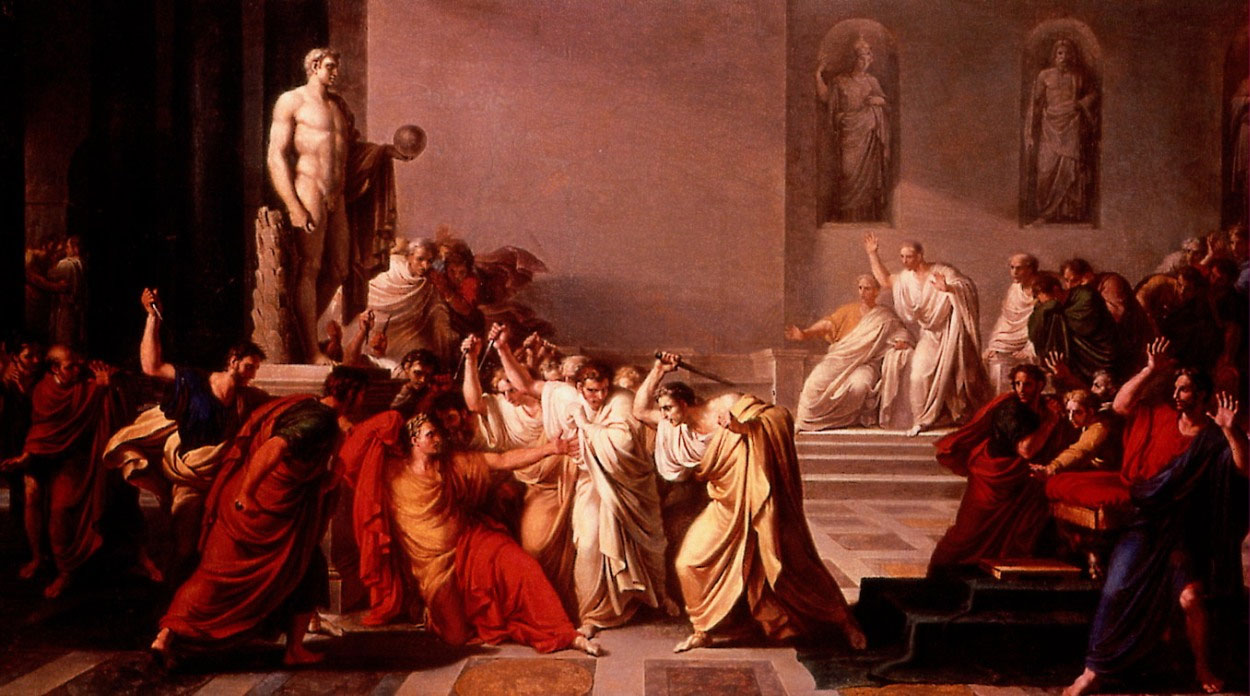
Death of Julius Caesar by Vincenzo Camuccini
Brutus and the conspirators betray Caesar and stabbs him to death
"Et tu, Brute?"
Those were the Julius Caesar's last words. Shakespeare brilliantly captured the death of Julius Caesar in the play The Tragedy of Julius Caesar. This play was based on a famous betrayal in Rome in 44 BC. Brutus was Caesar's most loyal servant and his most trustworthy friend; however, Brutus betrayed Caesar and joined the conspirators whom stabbed Caesar to death. Brutus was a very well respected member of the Roman Republic senate, and Caesar loved him like his own son. When Cassius convinced Brutus to kill Caesar, Brutus devoted himself to the death of Julius Caesar, believing it was for the good of the Roman Republic.
The deaths of Julius Caesar and Duncan were very similar. They both had trustworthy friends (Brutus and Macbeth), who betrayed and killed them. Macbeth also never thought about killing Duncan, but the Three Witches and his wife, Lady Macbeth, convinced him that he should step up and kill Duncan. Like Brutus, Macbeth felt that his actions were justible because others believed the same thing. The witches had prophesized that he would, and Lady Macbeth persuaded him to execute the assassination. He succumb to the idea of supernatural powers and betrayed the king. If Duncan was alive before Macbeth stabbed him, he might have said something like "Et tu, Macbeth?"
Tuesday, April 1, 2008
First Socratic Seminar about MacBeth

Our favorite in Mr.Saxon's class is no doubt Socratic seminar. You get in circles and discuss about weekly topics; this week the topic was what we think of Macbeth? Like all Shakespeare plays, Macbeth contains English style that we, people of 21st century, don't understand very well. Shakespeare's language is confusing at first; however when you give it time, it becomes like your second nature. First reaction of reading Macbeth was "Oh no! Not this again. It took me forever to read Romeo and Juliet in middle school!" I was ready to rely completely on Sparknote for translation, but shockingly I didn't need it. I totally agree with my peers how Shakespeare language is confusing and sometimes impede our understanding of the play, but the language defines Macbeth and other Shakespeare plays. The present English translation lacks that weird, indescribable vibe that makes Macbeth amazing. Without Shakespeare language, Macbeth is nothing but a history book describing a rebellion in Scotland.
Tuesday, March 25, 2008
Introduction is the most important part of the story
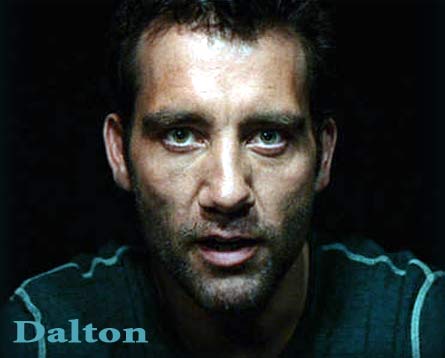
"My name is Dalton Russell. Pay strict attention to what I say because I choose my words carefully and I never repeat myself. I've told you my name: that's the Who. The Where could most readily be described as a prison cell. But there's a vast difference between being stuck in a tiny cell and being in prison. The What is easy: recently I planned and set in motion events to execute the perfect bank robbery. That's also the When. As for the Why: beyond the obvious financial motivation, it's exceedingly simple... because I can. Which leaves us only with the How; and therein, as the Bard would tell us, lies the rub"
The movie The Inside Man starts out by the main character, Dalton Russell, flat out saying that he committed a bank robbery. Like Dalton said, his words are chosen very well. When you watch the movie, you are mezmorized by his words. "Pay strict attention to what I say...the Where could most readily be described as a prison cell." What kind movie starts by spoiling the "Oo, is he going to get caught?" suspense? Well guess what? The movie The Inside Man does a wonderful job at catching the audience's attention by revealing small part of the whole plot. Now all you think about is "How? How does he get caught?" This added suspense makes the movie more enjoyable to watch.
 This method of foreshadowing the the main plot was also used in Shakespeare's Macbeth. The three witches opens the play with ominous prediction. Then when they meet Macbeth and Banquo, they chant "All hail, Macbeth! Hail to thee, thane of Glamis/All hail, Macbeth! Hail to thee, thane of Cawdor/All hail, Macbeth, that shalt be king hereafter!" Foreshadowing the plot in the beginning of the play or the book is a great introductionto catch the audience's attention. From what the witches say and how Macbeth reacts to them, we can surmise that there will be more mysterious scenes that entices the audience for more. The idea of predestination and fate will also appear often in the story because the three witches keep surprising us with predictions that came true.
Subscribe to:
Posts (Atom)
